
The Future of Cleaning Companies in UAE Hospitality
In the heart of the UAE’s booming hospitality sector, where luxury hotels and resorts welcome millions of tourists each year, one truth stands unchallenged: cleanliness defines excellence. Post-pandemic, guests demand not just pristine environments but verifiable hygiene standards that elevate experiences from memorable to legendary. Occupancy rates in Dubai and Abu Dhabi have surged past 80 percent, fueling a market projected to exceed AED 50 billion by 2025. Yet, this growth amplifies a pivotal challenge for every operation.
This is where the cleaning company emerges as a strategic powerhouse. Far beyond traditional janitorial services, forward-thinking cleaning companies in UAE hospitality are redefining standards through innovation and efficiency. As regulatory pressures mount and sustainability mandates intensify, their role evolves from reactive maintenance to proactive partnership.
In this in-depth analysis, we dissect the transformative forces at play: cutting-edge technologies like AI-driven disinfection robots, eco-friendly protocols aligned with UAE Vision 2031, workforce upskilling imperatives, and data-backed strategies for cost optimization. Business leaders and hospitality executives will uncover actionable insights to future-proof their operations, ensuring their properties remain competitive in a landscape of unrelenting ambition.
UAE Cleaning Services Market Overview
The UAE cleaning services market stands as a cornerstone of the nation’s burgeoning service economy, valued at USD 6.45 billion in 2024 and projected to expand to USD 9.02 billion by 2030, achieving a compound annual growth rate (CAGR) of 5.6%, according to Research and Markets’ comprehensive report. This robust trajectory underscores the sector’s resilience amid economic diversification efforts, with Dubai commanding approximately 40% market share due to its status as a global tourism hub. Alternative projections from IMARC Group estimate a slightly more conservative USD 2.10 billion in 2025, growing to USD 3.23 billion by 2034 at a 4.9% CAGR, highlighting variances in scope that include residential maid services versus broader commercial applications. For cleaning companies targeting intermediate growth, these figures signal prime opportunities in outsourcing trends, where facility managers increasingly prioritize certified providers to meet regulatory compliance in high-traffic environments. Actionable insight: Businesses should benchmark against these projections by auditing current contracts for scalability, focusing on long-term partnerships in real estate and hospitality developments.
Hospitality Segment Growth
Within this landscape, the hospitality segment emerges as a high-growth niche, particularly for industrial and institutional cleaners essential to hotel and resort operations. MarkNtel Advisors forecasts this sub-market at USD 142.29 million in 2025, surging to USD 189.29 million by 2030 at a 5.87% CAGR, driven by end-users like hotels, restaurants, and resorts under the UAE Tourism Strategy 2031, which aims for a AED 450 billion GDP contribution from travel. This expansion aligns with record visitor numbers, such as Dubai’s 17.55 million overnight tourists from January to November 2025, necessitating specialized deep cleaning, disinfection, and post-event services. For instance, luxury properties in Abu Dhabi and Dubai now integrate routine hygiene protocols into fit-out maintenance, amplifying demand for eco-certified solutions. Cleaning companies can capitalize by offering bundled services like carpet care and window cleaning tailored to 5-star standards, with data showing over 60% of UAE residents favoring sustainable options per recent YouGov surveys. Strategic tip: Invest in staff training for hospitality-specific protocols to secure recurring contracts amid 90,000 new residential units by 2025.
Key Growth Drivers
Urbanization propels demand, with the UAE’s urban population at 88.01% in 2024, fueling infrastructure projects that require commercial cleaning for offices, malls, and public spaces. A tourism boom, evidenced by exponential hotel occupancy rates, compounds this, as events like Expo remnants and Formula 1 demand impeccable standards. Post-pandemic hygiene regulations, including Dubai Municipality guidelines and Federal Law No. 33, have institutionalized outsourcing, with healthcare facilities exceeding 5,020 in Dubai alone. These drivers shift focus from residential (32% share) to commercial segments, where dual-income households and 180,000 expatriate domestic workers underscore professional service needs. Trends like AI-driven scheduling and robotic vacuums further enhance efficiency, positioning tech-savvy cleaning companies for premium pricing.
Global and Regional Context
Globally, “cleaning company” generates 40,500-60,500 monthly searches, reflecting high-intent queries for house, commercial, and deep cleaning services, with UAE variants like “cleaning company Dubai” dominating local SEO. In the Middle East & Africa (MEA) region, the market hits USD 35.37 billion in 2025, growing at 6.7% CAGR through 2033, outpacing UAE rates due to pan-regional urbanization. This context positions UAE firms advantageously within a USD 292.67 billion global commercial cleaning arena (2022 baseline), emphasizing sustainability and digital platforms for competitive edge. For operators, monitoring MEA trends offers expansion insights, such as green certifications to align with 2030 carbon goals.
Key 2026 Growth Statistics and Projections
UAE Cleaning Market Evolution Toward 2026
The UAE cleaning services market has undergone significant transformation since 2020, setting the stage for robust 2026 projections. According to IndustryARC research, the market stood at USD 2.3 million in 2020 and expanded at a compound annual growth rate (CAGR) of 5.3% through 2026, reaching an estimated USD 3.15 million by that year. This growth reflects early post-pandemic recovery, with commercial segments like hotels and offices leading due to heightened hygiene demands in high-traffic hospitality venues. Industrial cleaning grew fastest at 5.8% CAGR, driven by construction booms and renovations in Dubai and Abu Dhabi, while residential services benefited from urbanization and dual-income households. Newer estimates, such as IMARC Group’s projection of USD 2.10 billion in 2025 scaling to around USD 2.20 billion by 2026, highlight a scaled-up trajectory amid tourism surges, with Dubai capturing 40% of the share. Actionable insight for cleaning companies: prioritize commercial hospitality contracts, as they accounted for the largest revenue in 2020 and continue fueling expansion through specialized services like floor and upholstery cleaning.
Regional Perspectives: Europe and Middle East Comparison
When viewed regionally, the Europe and Middle East cleaning services market provides critical context for UAE players aiming for 2026 scalability. Fortune Business Insights values this market at USD 139.57 billion in 2024, forecasting growth to USD 217.25 billion by 2032 at a 5.69% CAGR, implying approximately USD 160-165 billion by 2026. Europe dominates with mature infrastructure in countries like Germany, contributing over 80% of the value through advanced facility management in healthcare and HoReCa sectors. The Middle East, including the UAE, accelerates via infrastructure projects and tourism, with floor care holding a 33% share and facility services growing rapidly. This regional CAGR slightly outpaces the UAE’s early 5.3% estimate, underscoring opportunities for UAE firms to adopt European tech like IoT monitoring for competitive edge. Cleaning companies should benchmark against these figures by investing in ESG-compliant products, as regulations in both regions demand biodegradable solutions to capture cross-border hospitality demand.
Global Commercial Cleaning Projections
Globally, the commercial cleaning sector underscores the UAE’s potential within a massive ecosystem. Gitnux data positions the market at USD 292.67 billion in 2022, advancing at a 6.8% CAGR to approximately USD 379 billion by 2026. This expansion stems from post-COVID disinfection protocols, with healthcare and hospitality segments surging 300% in specialized services. Key drivers include robotic adoption for 20% labor savings and AI scheduling in 60% of firms, alongside a global workforce of 20-25 million, 60% focused on commercial spaces. For UAE cleaning companies, this translates to emulating global trends like green products, which have risen 40% since 2020, to secure premium hotel contracts amid 17 million annual tourists. Strategic insight: integrate robotics early, as Middle East adoption in airports signals 2026 efficiency gains over manual methods.
Search Volume Impact on Local SEO in Hospitality Hubs
High-intent search terms like “cleaning company” profoundly influence 2026 growth, particularly in Dubai and Abu Dhabi hospitality sectors. With 40,500-60,500 monthly global searches, this keyword drives local SEO, associating with commercial and deep cleaning services amid urbanization and tourism. In the UAE, variants such as “cleaning company Dubai” and “hotel cleaning services UAE” spike due to 17.55 million visitors, amplifying demand for post-construction and routine maintenance in hotels. Google Maps rankings and reviews become pivotal, as digital trends favor on-demand apps and niche hospitality services, with wages rising 8-12% shifting focus to commercial. Cleaning companies gain actionable leverage by optimizing for these terms, targeting 22-32% hospitality market share through Google Ads and social proof. This SEO momentum positions UAE firms for sustained 5-9% CAGR, blending tech integration with sustainability for long-term dominance.
These projections reveal a market ripe for innovation, where UAE cleaning companies leveraging data-driven strategies can thrive in hospitality’s evolution.
Sustainability and ESG in Cleaning Services
The cleaning services industry in the UAE is experiencing a marked shift toward sustainability and ESG principles, particularly within the hospitality sector, driven by stringent regulations and growing environmental awareness. Hospitality establishments are increasingly adopting eco-friendly products, such as no-rinse cleaners that minimize water usage by up to 20% through biodegradable formulas that eliminate the need for rinsing steps. This aligns with Dubai’s Department of Economy and Tourism (DET) Hotel Classification System, which mandates higher-star hotels to reduce harmful chemicals, track consumption per guest night, and boost eco-certified alternatives by 10% annually. Green certifications like EcoLabel UAE, Green Seal GS-37, ISO 14001:2015, and ESMA compliance are becoming essential, enabling compliance with LEED and GSTC standards while supporting the UAE Net Zero 2050 Strategy. These measures not only cut hazardous waste and improve indoor air quality but also position cleaning companies as partners in sustainable tourism. For instance, low-VOC cleaners and refillable dispensers are prioritized in Abu Dhabi guidelines to address water scarcity and waste reduction goals.
Leading cleaning companies exemplify this trend through comprehensive ESG integration. Cleanco.ae, with 15,000 employees across the UAE, emphasizes sustainability via ISO 14001:2015 certification, low-VOC dilution systems, energy-efficient equipment, and waste recycling tailored for hospitality clients. Their practices include LEED-compliant tools and 24/7 training on green disinfection protocols aligned with health authority standards. This approach reduces carbon footprints and supports 7-star hygiene levels in hotels and leisure facilities. Such initiatives demonstrate how large-scale operations can scale eco-practices without compromising efficacy, setting benchmarks for the sector.
Looking to 2026, ESG compliance will emerge as a critical differentiator in the UAE’s tourism-driven market, where the cleaning services sector is projected to grow at a 5.1% CAGR from USD 2.10 billion in 2025. Mandatory GHG reporting for listed firms and single-use plastic bans effective January 2026 will compel providers to adopt net-zero procurement and data-driven metrics. In a landscape where 66% of UAE consumers favor sustainable brands, non-compliant firms risk fines and lost tenders, while leaders gain 10-20% revenue premiums from green services. Tourism hubs like Dubai and Abu Dhabi, aiming for eco-travel leadership, will prioritize providers with verified ESG credentials amid urbanization and post-pandemic hygiene demands. For more on UAE ESG regulations, see ESG reporting requirements in the UAE and ESG compliance explained.
Hospitality clients should prioritize certified cleaning providers to align with global standards like GRI and TCFD, yielding 8-20% utility savings and enhanced guest appeal. Conduct supplier audits for safety data sheets, certifications, and consumption metrics; embed ESG KPIs in contracts, such as annual increases in green products. Invest in no-rinse technologies to meet water security mandates. This strategic focus not only ensures regulatory adherence but also elevates brand reputation in a competitive market. Detailed market outlook available here.
Technology Transforming Cleaning Companies
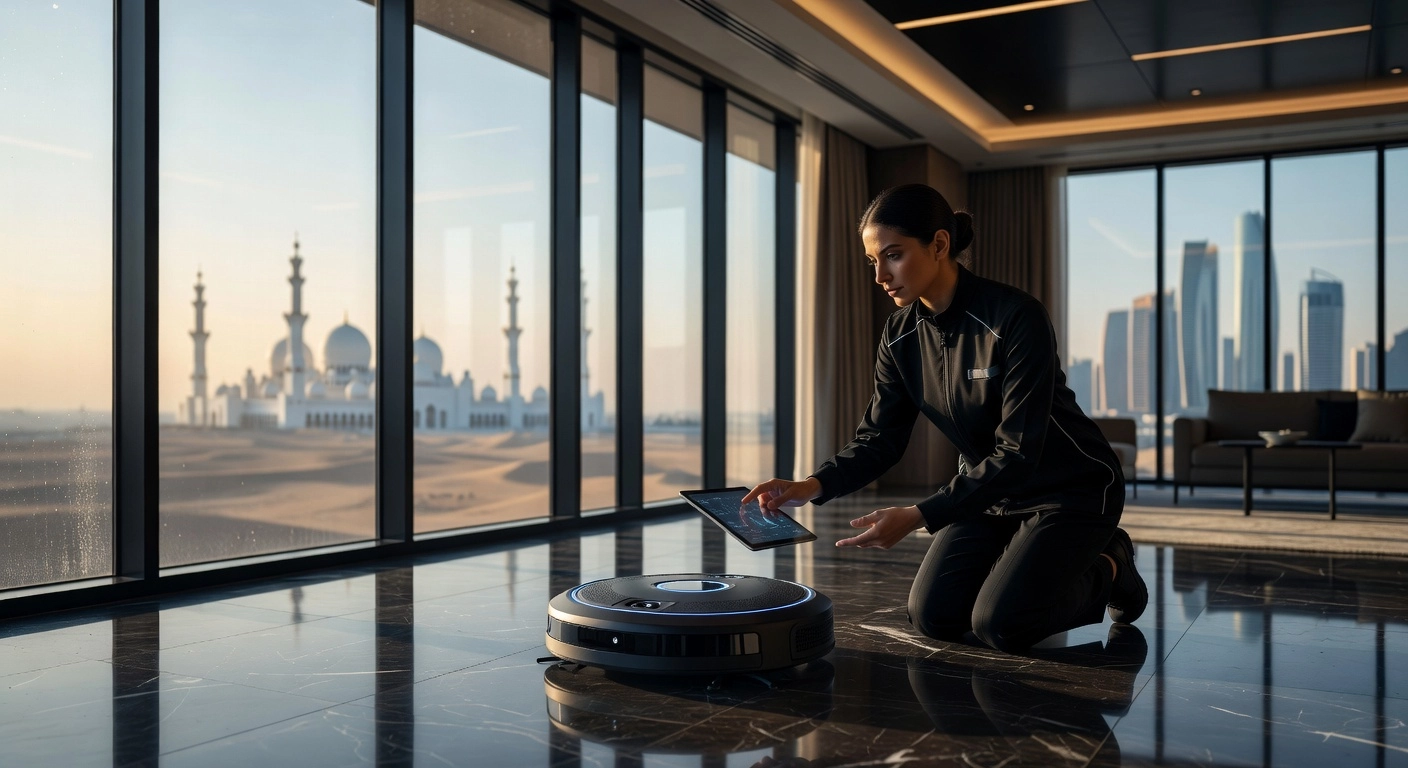
The cleaning industry in the UAE is experiencing a seismic shift through advanced technologies like AI-driven scheduling, robotics, and smart facilities management, as outlined in Clean Middle East’s 2026 projected trends. These innovations align with the UAE AI Strategy 2031 and rapid urbanization, propelling the regional commercial cleaning robots market at a 16.4% CAGR, from USD 22.5 million in 2025 to USD 75.9 million by 2033. Cleaning companies adopting hybrid human-robot models in hospitality and high-traffic venues achieve up to 30% reductions in unnecessary labor hours by leveraging real-time data from IoT sensors on footfall, occupancy, and asset conditions. Robotics excel in repetitive tasks such as floor scrubbing, delivering 40% greater efficiency than manual methods with 24/7 operation and full path coverage. Smart facilities management further integrates predictive maintenance and indoor air quality monitoring via digital twins, optimizing energy use and supporting ESG goals. This adoption creates new roles like robot supervisors, enhancing operational resilience in dynamic environments like hotels and malls.
Robotics deliver substantial efficiency gains, particularly in labor-intensive large-scale hotel cleans where personnel costs comprise 80% of expenses amid high turnover and rising wages. Autonomous units save four human labor hours daily on floor maintenance, covering 40,000 square feet per shift compared to 15,000 manually, with 100% path coverage versus typical 15% misses. Hotels report 25% higher cleanliness scores, 10-15% budget reductions in floor care, and 33% improved facility utilization through overnight operations. In the UAE hospitality sector, these tools enable housekeepers to manage three additional rooms per shift by delegating hallways and common areas. Predictive staffing via AI cuts overall costs by 25%, while smart dispensers reduce chemical and water waste by 40%, yielding 12-18 month ROI. Cleaning companies can prioritize high-value tasks, boosting competitiveness in tourism-driven markets.
CleanerHQ’s 2026 insights highlight AI scheduling as a top opportunity, offering 15-25% productivity boosts through route optimization and real-time traffic data for commercial cleaning firms. IoT provides actionable insights on air quality and usage patterns, enabling data-driven decisions across portfolios and countering margin pressures from labor inflation. Online quoting tools slash admin time by 30-50%, facilitating premium hospitality contracts with 30-50% higher margins for specialized disinfection.
Technology stacks empower scalable services for post-renovation deep cleans and routine hospitality maintenance, handling debris removal, antimicrobial treatments, and duct polishing with precision. AI adjusts dynamically for occupancy spikes post-renovation, while digital platforms automate booking and tracking for multi-site operations, minimizing errors. Subscription models for air quality monitoring ensure consistent revenue, supporting 24/7 hybrid ops in UAE high-rises and hotels, as per MEA commercial cleaning robots outlook. This scalability positions cleaning companies to meet surging demands from hospitality expansions.
UAE Cleaning Company Competitive Analysis
Market Leaders in UAE Cleaning Services
In the competitive landscape of UAE cleaning companies, three standout players dominate distinct niches, shaping the market for hospitality and commercial clients. Cleanco.ae leads in scale as a national facility management pioneer established in 1980, employing over 15,000 staff across Dubai, Abu Dhabi, and Al Ain. It serves more than 450 clients in government and private sectors, offering comprehensive housekeeping, general cleaning, hospitality operations, waste management, and landscaping. Certified under ISO 14001:2015 for sustainability and ISO 45001:2015 for safety, Cleanco elevates guest experiences in hotels through rigorous hygiene protocols, though employee reviews on platforms like Indeed average around 3 out of 5, citing teamwork strengths alongside salary concerns. Cleanie.ae excels in luxury hotels with over 20 years of experience, providing premium commercial cleaning for high-end properties, offices, retail spaces, and construction deep cleans using fully screened professionals. Boasting a 4-star Trustpilot rating from 19 reviews, it customizes solutions for upscale environments like serviced apartments. SPME Cleaning, based in Dubai’s Trade Centre, specializes in deep cleans, handling chandelier polishing, facade maintenance, rope access, window cleaning, and janitorial services for luxury high-rises. Its portfolio includes prestigious clients such as Royal Atlantis Resort, Dubai Airport VIP lounge, Sofitel, and Rotana hotels, with testimonials highlighting precision for hotel openings and delicate art pieces.
Strengths: Dominance in Local SEO and Digital Visibility
These leaders leverage robust local SEO strategies, securing top Google Maps rankings that capture 75% of clicks in the UAE market, where 80% of customers choose from the local pack’s top three results. Cleanco.ae optimizes service-specific pages for broad searches like housekeeping and general cleaning across emirates, bolstering its scale advantage amid UAE Cleaning Services Market growth to USD 9.02 billion by 2030. Cleanie.ae and SPME Cleaning feature targeted pages for commercial hospitality and deep cleans, such as hotel chandelier services, driving traffic for queries like “hotel deep cleaning Dubai.” High review volumes and quality, including Cleanie’s 4.9/5 Google ratings and SPME’s client endorsements, enhance proximity signals and trust. Active Google Business Profile management, with photos and Q&A, amplifies rankings threefold per SEO analyses, positioning them ahead in Dubai and Abu Dhabi lists. Actionable insight: Cleaning firms should prioritize content clusters and review responses to sustain this edge in a market fueled by 17 million tourists in 2025.
Gaps: Lack of Integration with Design Fitouts
Despite strengths, these cleaning companies exhibit a critical gap in bundling services with architectural and interior design fitouts, particularly for hospitality projects. They operate as standalone providers, focusing on post-occupancy maintenance rather than seamless integration from construction handover. Firms like Nujum Alrabie fill this void through full-cycle expertise in hotel interiors, encompassing concept design, custom carpentry, painting, gypsum works, renovations, and landscaping. NAR’s end-to-end model ensures coordinated transitions, minimizing downtime in new builds where dust removal and prep cleaning align with fitouts. This specialization addresses unmet needs in the hospitality segment, which commands 30-40% of cleaning demand.
Market Share Implications for Hospitality Post-Construction Cleaning
Hospitality clients seeking specialized post-construction cleaning face a fragmented market, with pure cleaning leaders holding 20-30% share in new hotel projects amid 20% sector growth and USD 2-3 billion projections by 2030. Without fitout integration, Cleanco, Cleanie, and SPME risk losing bids to holistic providers like Nujum Alrabie, whose model reduces project timelines by up to 15% through partnerships. Deep cleaning demand surges with 150+ Dubai hotel developments by 2026, favoring bundled services per Fortune Business Insights. Leaders can counter by forming facility management alliances and optimizing for “post-construction hotel cleaning Dubai.” Clients benefit from actionable strategies like vetting providers for design synergies to optimize costs and hygiene in tourism-driven UAE. This shift underscores opportunities for innovative cleaning companies to evolve beyond silos.
Cleaning Challenges in UAE Hospitality
Post-Fitout and Renovation Cleans: Essential for Hygiene Compliance
Hospitality projects in the UAE, particularly after interior fitouts and renovations, demand rigorous post-construction cleaning to eliminate dust, debris, and residues from new installations. With 1,189 hotels boasting 203,000 rooms and ongoing upgrades amid a construction boom, these deep cleans target floors, walls, windows, and HVAC systems to meet Dubai Municipality standards and the 2025 Public Health Law. Non-compliance risks fines, reputational damage, and delayed reopenings, as seen in recent hotel conversions requiring medical-grade sanitization of high-touch areas. Cleaning companies employ steam cleaning, UV sterilization, and nanotechnology coatings, achieving cleanliness scores above 99.5% through structured audits. For firms like architectural specialists handling hospitality interiors, partnering with certified providers ensures seamless transitions, preventing guest safety issues. Actionable insight: Schedule pre-opening inspections with infection control protocols to align with brand-specific KPIs.
Routine Maintenance Demands Amid Busy Lifestyles and Tourism Surge
The UAE’s hospitality sector grapples with relentless routine cleaning needs, driven by 17.55 million overnight tourists in 2025 alone and 79.5% hotel occupancy rates. Urban lifestyles, with 88% of the population city-dwelling and expatriate-heavy workforces exceeding 11.3 million, amplify daily demands in restaurants, pools, spas, and lobbies requiring 24/7 sanitation and food-safety measures. High tourism volumes, projected to contribute AED 450 billion to GDP, necessitate real-time monitoring via IoT sensors for air quality and foot traffic. Cleaning companies integrate AI scheduling and robotics for predictive maintenance, shifting from reactive to condition-based protocols that handle peak loads efficiently. This is crucial post-pandemic, where lapses in restroom or common area upkeep violate health guidelines. Operators gain 15-25% efficiency by adopting these tools, ensuring consistent standards without disrupting operations.
Wage Pressures: 8-12% Increases Favoring Efficient Commercial Providers
Rising wages, up 8-12% globally in 2026, intensify cost pressures in UAE hospitality cleaning, outpacing residential sector growth and prompting 6-9% price hikes. Emirati minimum wage rises to AED 6,000 monthly from January 2026, coupled with labor shortages, high turnover, and expatriate regulations, challenge in-house teams managing 180,000+ domestic workers in Dubai. Hospitality firms counter this through outsourcing to commercial cleaning companies offering SLAs, KPIs, and tech-driven efficiencies like VR training and robotics, reducing manual labor dependency. Investments in over 560,000 training hours yield better margins, especially in premium niches like post-construction cleans commanding 30-50% higher rates. This shift enables focus on core operations while providers deliver green practices and scalability. Insight: Evaluate partners on tech adoption and certification to offset costs and maintain service levels.
Urbanization and Post-Pandemic Hygiene: Demanding Reliable Partners
Rapid UAE urbanization, with GCC urban residents reaching 54.6 million by 2030, heightens hygiene expectations in dense hospitality hubs under post-COVID scrutiny. The 2025 Public Health Law enforces elevated sanitization in hotels and public spaces, sustaining demand for deep cleans beyond routines via autonomous robots and blockchain traceability. This environment, fueled by tourism recovery and busy lifestyles, requires partners adept in ESG alignment, like 50% renewable energy targets by 2050. Cleaning companies provide proactive prevention through data-driven models, building trust amid market growth from USD 6.45 billion in 2024 to USD 9.02 billion by 2030. For interior design projects in hospitality, reliable providers ensure long-term facility health. Forward-thinking operators prioritize vetted collaborators for sustained compliance and guest satisfaction.
Integrated Solutions: Design Meets Cleaning
In the fast-paced world of UAE hospitality, where renovations and fitouts must align perfectly with operational demands, bundling interior design services with professional cleaning from a single provider like Nujum Al Rabie delivers unmatched efficiency. This integrated approach eliminates the silos that plague multi-vendor projects, ensuring that creative interiors transition seamlessly into pristine, guest-ready spaces. For instance, post-fitout cleaning removes construction dust, paint residues, and debris that could compromise air quality or aesthetics, allowing hotels and restaurants to open on schedule without additional delays. Hospitality operators benefit from reduced coordination efforts, as one team handles design conceptualization, gypsum installations, custom carpentry, and final deep cleans, including AC duct and sofa maintenance. This not only cuts project timelines by 20-30 percent but also minimizes costs through streamlined logistics and unified accountability. Ultimately, such bundling elevates guest satisfaction, aligning with Dubai’s 78.1 percent hotel occupancy rates in late 2024, where every hour of downtime impacts revenue.
Nujum Al Rabie’s Expertise in Renovations with Coordinated Cleaning
Nujum Al Rabie, a Dubai-based firm specializing in architectural and interior design for hospitality, exemplifies how coordinated cleaning elevates renovation outcomes. Their end-to-end services cover everything from initial layouts for hotels and F&B outlets to post-renovation deep cleans, ensuring projects meet the highest standards of excellence. In villa transformations and luxury suite overhauls, their multicultural team integrates fitouts with specialized cleaning to prevent defects like lingering odors or surface damage, delivering punctual, safe handovers. Social media showcases their prowess in seasonal refreshes for spas and restaurants, where cleaning follows painting and carpentry to maintain hygiene compliance. This expertise supports Dubai’s D33 tourism agenda, incorporating sustainable materials and smart tech for long-term functionality. Clients praise the flawless results, positioning Nujum Al Rabie as a reliable partner for hospitality excellence.
Low-Competition Opportunities in Post-Fitout Cleaning
Strategic niches like post-fitout cleaning in Dubai offer cleaning companies high-margin growth amid low SEO competition. With the UAE interior fit-out market expanding from USD 3.08 billion in 2024 to USD 4.13 billion by 2030 at a 5 percent CAGR, demand for specialized post-renovation services surges, yet long-tail terms such as “post-fitout cleaning Dubai” face minimal rivalry compared to generic searches. The UAE cleaning services sector, valued at USD 6.45 billion in 2024 and growing to USD 9.02 billion by 2030, underscores this potential, particularly with 20 new hotels annually driving renovation needs. Providers bundling these services capitalize on urbanization and hygiene standards, targeting underserved segments like hotel deep cleans. Actionable insight: Optimize local SEO with Google Maps reviews and niche content to dominate these queries, yielding 15-25 percent efficiency gains.
Data-Backed Case for Full-Service Providers
Hospitality leaders should prioritize full-service providers for tangible ROI, backed by robust metrics.
| Metric | 2024/2025 Value | Projection | CAGR/Source |
|---|---|---|---|
| UAE Hospitality Market | USD 27.87B | USD 43.92B by 2031 | Mordor Intelligence |
| Dubai Hotel Rooms | 154,016 | +20 openings/year | KPMG Report |
| UAE Fit-Out Market | USD 3.08B | USD 4.13B by 2030 | TechSci Research |
Full-service models reduce costs by 15-20 percent, ensure ESG compliance with green cleaning, and meet 2026 trends like AI scheduling. With UAE hospitality growing 8-10 percent yearly and 18.72 million tourists in 2024, integrated solutions from firms like Nujum Al Rabie provide a competitive edge in this booming landscape.
Conclusion: Strategic Takeaways for Leaders
In the UAE cleaning services market, poised to grow from USD 6.45 billion in 2024 to USD 9.02 billion by 2030 at a 5.6% CAGR, leaders must prioritize providers with sharp competitive edges like eco-friendly practices and tech integration. Global commercial cleaning trends mirror this, expanding at 6.8% CAGR through 2026 amid urbanization and hospitality demands. Informed selection hinges on firms excelling in post-renovation deep cleans and hotel hygiene, ensuring compliance and guest satisfaction.
Evaluate potential cleaning companies on sustainability adoption, such as green certifications and no-rinse cleaners, alongside tech like AI scheduling and robotics for efficiency. Assess local SEO strength, vital for high-intent searches like “cleaning company Dubai,” to guarantee visibility in tourism hubs. These metrics future-proof operations against 2026 projections.
For optimal results, integrate cleaning with design maintenance services, slashing costs by 15-20% through streamlined fitouts and upkeep, as seen in hospitality renovations. Audit current providers now against these benchmarks and explore partnerships with firms like Nujum Alrabie (NAR) to elevate hospitality excellence. Act decisively to capture market growth.
0 comments