

How to Choose an Interior Design Contractor in Dubai
Dubai’s interior design industry is booming, and with hundreds of contractors competing for your project, making the right choice has never been more critical or more confusing. Whether you are renovating a luxury apartment in Downtown Dubai or fitting out a commercial space in Business Bay, the contractor you hire will determine whether your vision becomes reality or turns into a costly disappointment.
Finding the right interior design contractor in Dubai requires more than browsing portfolios and comparing quotes. It demands a structured approach, a sharp eye for red flags, and a clear understanding of what separates truly professional firms from those that simply look impressive on Instagram.
In this analysis, we break down the key factors you must evaluate before signing any contract. From verifying trade licenses and assessing past project experience to understanding payment structures and communication standards, you will walk away with a practical framework for making a confident, informed decision. If you are serious about protecting your investment and achieving exceptional results, this guide will give you the clarity you need to move forward.
Why Dubai Demands Integrated Design and Execution
Dubai’s interior design and construction market has reached a scale where fragmented service delivery is no longer a viable option for serious developers and investors. The UAE interior design market is valued at USD 1.94 billion in 2026 and is projected to reach USD 3.11 billion by 2031, expanding at a compound annual growth rate of 9.83%. Within that figure, Dubai commands a dominant 51.74% share of the national market, reflecting the emirate’s concentration of luxury residential towers, flagship hotels, and mixed-use mega-developments. This is not a market where incremental design tweaks and modest fit-outs define the norm; premium villa fit-outs in Dubai routinely exceed AED 9,000 per square meter, setting a benchmark that demands both design sophistication and construction-grade delivery precision.
The transactional velocity of Dubai’s real estate sector further intensifies this pressure. Dubai recorded AED 142.7 billion in real estate transaction volume in Q1 2025 alone, representing a 30% year-over-year increase in value. Every completed transaction representing an off-plan unit, branded residence, or commercial asset eventually generates a fit-out requirement. When that volume is sustained across consecutive quarters, the cumulative demand for firms capable of handling both creative vision and on-site execution becomes structural rather than cyclical.
Policy imperatives are adding a parallel layer of demand. The Dubai 2040 Urban Master Plan includes retrofit mandates requiring building owners to upgrade existing assets to meet updated energy-efficiency and sustainability standards. These obligations translate into a sustained pipeline of renovation and fit-out projects, each requiring tight coordination between design intent and construction execution. A fragmented approach, where a separate design firm hands over drawings to a separate contractor, introduces misalignment risks that retrofit timelines and regulatory deadlines cannot accommodate.
The hospitality sector amplifies this dynamic considerably. Dubai carries over USD 100 billion in committed hospitality capital across luxury resorts, branded residences, and mixed-use projects currently in various stages of development. Hotel operators and developers working within this pipeline need partners who can translate ambitious creative briefs into delivered interiors without losing fidelity between concept and completion. Single-vendor accountability has become the operational standard preferred by investors who recognize that misalignment between designers and contractors is one of the most consistent sources of cost overruns and schedule delays in complex fit-out projects.
Designer vs. Contractor vs. Integrated Firm: Understanding the Difference
When selecting a firm for a project in Dubai, one of the most consequential decisions a client makes is understanding precisely what type of entity they are hiring. The market uses terminology loosely, and the distinctions between these three delivery models carry real consequences for budget, timeline, and final quality.
The Pure Interior Designer
A pure interior design consultancy specializes in the creative and technical documentation phase of a project. Their deliverables typically include concept development, mood boards, space planning, material specifications, 3D renderings, and construction drawings suitable for tendering. What they do not provide is equally important: they generally do not hold a contractor’s license, manage on-site trades, coordinate MEP systems, or take responsibility for procurement and physical build quality. Their involvement peaks during the design phase and tapers significantly once documentation is handed to an execution team. For straightforward projects with experienced client-side project managers, this separation can work. For complex hospitality or luxury residential schemes, it introduces coordination gaps that consistently translate into cost overruns and diluted design intent.
The Fit-Out Contractor
A fit-out contractor operates at the opposite end of the spectrum, focusing on physical execution. Core capabilities include partition construction, joinery and carpentry, flooring, ceilings, MEP coordination, procurement, and authority approvals with bodies such as Dubai Municipality. Technical proficiency is generally strong. However, many fit-out contractors lack in-house creative depth or the design development capability required for nuanced, high-end hospitality environments where aesthetic judgment must be continuously exercised throughout construction. They rely on external designers’ drawings, which reintroduces the coordination risk the client sought to eliminate. Understanding the practical differences between fit-out and interior design services is foundational before any procurement decision.
The Integrated Firm and Turnkey Delivery
An integrated interior design and execution firm combines both functions under a single contract and a single point of accountability. The project lifecycle, from initial concept through procurement, construction, and final handover, is managed by one team with shared objectives. Turnkey delivery, the practical expression of this model, means the client receives a fully completed, operational space without managing separate vendor relationships. This structure eliminates the fragmentation that generates timeline overruns, change-order disputes, and quality inconsistencies, particularly critical given that fit-out and design integration directly affects how design intent survives the construction phase on complex projects.
Due Diligence When Issuing RFPs in Dubai
This distinction becomes strategically critical when shortlisting firms or issuing requests for proposals. A significant number of firms in Dubai market themselves as integrated or turnkey providers while subcontracting the majority of execution, retaining limited design control and functioning more as intermediaries than genuine full-service operators. The coordination risks clients pay a premium to avoid are quietly reintroduced. Thorough due diligence requires reviewing in-house team structures, examining previous comparable projects, and scrutinizing contract terms to confirm whether design control is genuinely retained through to handover. For hospitality clients in particular, where the integrity of the design narrative must survive every phase of execution, this verification is not optional; it is the difference between a delivered vision and a compromised one.
What to Look for in an Interior Design Contractor in Dubai
Having established the structural differences between designers, contractors, and integrated firms, the next critical step is knowing precisely what to evaluate before committing to any engagement. Dubai’s market offers no shortage of options, but not all firms operate with equal legitimacy, depth, or accountability.
Licensing and Legal Standing Come First
Before reviewing a single mood board or portfolio, verify that the firm holds a valid trade license issued by the Department of Economic Development and is registered with Dubai Municipality for contracting or fit-out activities. Unlicensed entities cannot legally manage construction or fit-out works in Dubai, and engaging one exposes clients to project halts, regulatory fines, and warranties that carry no legal weight. Request copies of current licenses, insurance certificates, and recent Dubai Municipality approvals as a baseline requirement. Dubai’s updated contractor registration framework, introduced in 2026, now integrates performance-based ratings covering financial solvency, timely delivery, and client feedback, making it easier to cross-check a firm’s standing through official portals before signing anything.
Relevant Experience Outweighs Raw Project Volume
A firm presenting 500 completed projects sounds impressive until you discover those projects are predominantly small residential apartments when your requirement is a full hotel fit-out. Sector-specific portfolio depth is the metric that actually predicts performance. For hospitality developers, a contractor with 20 completed hotel or F&B projects, documented with detailed millwork specifications, MEP coordination records, and phased delivery timelines, offers far greater confidence than a high-volume generalist. When reviewing portfolios, look for comparable scale, documented before-and-after evidence, and proof that the firm has navigated Dubai-specific constraints such as developer NOC requirements and high-temperature material performance standards.
Process Transparency Reduces Client-Side Risk
On large or complex projects, the quality of a firm’s internal processes matters as much as its design sensibility. Firms that provide documented project stages, regular reporting cadences (weekly site updates, milestone dashboards, photographic progress logs), and clear change-order management protocols significantly reduce the uncertainty that drives budget overruns and timeline slippage. According to recent analysis of the UAE interior design market, the GCC sector is projected to exceed USD 19.97 billion by 2030, reflecting a market where operational rigor is becoming a genuine differentiator, not just a nice-to-have.
Post-Handover Capability Signals Operational Maturity
The relationship with a quality interior design contractor in Dubai should not end at handover. Firms offering structured post-completion support, including snagging resolution, maintenance contracts, warranty management, and landscaping refresh services, reduce the client’s vendor coordination burden substantially. Written warranties covering workmanship and materials, access to as-built drawings and MEP manuals, and dedicated aftercare contacts during the first 6 to 12 months are all indicators that a firm operates as a long-term partner rather than a transactional supplier. This capability matters especially in Dubai’s climate, where finishes and materials face accelerated wear from heat and humidity.
Client References Provide the Most Reliable Quality Signal
Awards and press features are marketing assets; direct references from comparable projects are evidence. Request contacts from three to five recent projects that closely match your scope in terms of sector, scale, and complexity, then ask specifically about budget adherence, communication quality, and post-handover responsiveness. For hospitality, commercial, or luxury residential clients, a contractor’s track record in your specific segment is a stronger predictor of outcome than any accolade. Cross-referencing third-party review platforms for consistent patterns and, where possible, conducting site visits to completed projects adds another layer of verification that no portfolio presentation can replicate.
The Fit-Out and Delivery Process Explained
Understanding the precise sequence of a professional fit-out engagement removes ambiguity from the client relationship and sets accurate expectations for budget, timeline, and deliverable quality. Across Dubai’s competitive market, where premium villa fit-outs routinely exceed AED 9,000 per square meter, disciplined process management is not a differentiator but a baseline requirement.
Stage 1: Concept Development and Schematic Design
Every project begins with a structured discovery phase in which the design team translates the client brief into tangible spatial propositions. This involves developing zoning strategies, circulation diagrams, mood boards, material palettes, and initial 3D visualizations that communicate the intended atmosphere before any commitment to detailed design. Nujum Alrabie approaches this stage by examining the human, practical, technical, and creative dimensions of the brief simultaneously, ensuring that aesthetic direction and functional requirements evolve together rather than in sequence. The output is a schematic package that the client can review, challenge, and approve, establishing a shared reference point for all subsequent work.
Stage 2: Design Development and Documentation
Once the concept is approved, the team advances to full design development, producing coordinated architectural drawings, finish schedules, FF&E specifications, lighting plans, and acoustic considerations. This phase is where design intent becomes buildable instruction. The documentation package serves dual purposes: it supports regulatory submissions to authorities such as Dubai Municipality and the Dubai Civil Defence, and it forms the contractor-ready tender package for pricing or direct execution. Precision at this stage is directly correlated with cost predictability downstream, as incomplete documentation is a leading cause of variation orders and schedule overruns on Dubai fit-out projects.
Stage 3: Contractor Coordination and Procurement
An integrated firm’s value becomes most visible during procurement, where supplier vetting, material sourcing, and subcontractor appointments must align with both the design specification and the approved budget. This stage includes value engineering exercises, long-lead item scheduling for custom joinery or imported stone, and formal authority approvals where applicable. Firms operating without integrated contracting capability frequently lose control of the project at this juncture, as gaps between the design intent and procurement decisions accumulate. The interior fit-out process in Dubai demands active coordination across multiple trade packages simultaneously to maintain programme integrity.
Stage 4: Fit-Out and Construction Phase
Physical execution follows a master programme that sequences joinery fabrication, MEP rough-in, structural modifications, flooring, wall finishes, ceiling systems, and furniture installation in a logic that minimises rework and interface conflicts. Site managers coordinate daily across trades, conduct quality inspections at defined hold points, and manage safety compliance in line with local regulations. For hospitality projects in particular, where operational deadlines are financially consequential, adherence to the programme is non-negotiable. Firms with embedded project management structures consistently outperform those relying on ad hoc coordination, particularly on complex multi-zone environments such as hotel lobbies, F&B venues, and branded residences.
Stage 5: Handover and Post-Completion
The final stage encompasses snagging, MEP commissioning, client walkthroughs, and the formal handover of as-built drawings, operation manuals, and warranty documentation. Snagging is a structured defect identification process, not an informal inspection, and reputable firms allocate dedicated time and resources to resolve every recorded item before sign-off. Nujum Alrabie extends its engagement beyond handover through ongoing maintenance services covering painting, gypsum repairs, custom carpentry, and general upkeep, embedding long-term accountability into the client relationship. This end-to-end model, from concept through to post-completion support, reflects the standard that sophisticated clients in Dubai’s hospitality and luxury residential sectors now expect as a baseline rather than a premium offering.
Hospitality Interior Design in Dubai: Sector-Specific Considerations
Dubai’s hospitality sector operates at a scale that demands a fundamentally different caliber of interior design contractor. With over USD 100 billion in committed capital flowing through the city’s hospitality pipeline, and approximately 19,200 new hotel rooms across 67 active development projects, the stakes for every design and delivery decision are exceptionally high. Contractors entering this sector cannot rely on residential or commercial experience alone. They must demonstrate verifiable familiarity with international hotel brand standards, operator-specific FF&E specifications, guest journey mapping, and phased delivery timelines that align precisely with construction milestones and soft opening schedules. A single coordination failure between design intent and operator requirements can result in costly redesigns, delayed openings, and reputational damage that affects multiple stakeholders simultaneously.
Multisensory Design as the New Standard
The most consequential shift in Dubai’s hospitality interior design landscape in 2026 is the decisive move away from visually driven aesthetics toward multisensory environments designed for emotional resonance. Guest expectations have matured beyond surface-level “Instagrammable” spaces. Leading hospitality operators now brief their design contractors on layered acoustic treatments, dynamic lighting systems that shift across the day, scent diffusion strategies tied to brand identity, and tactile material selections that communicate warmth, authenticity, and belonging. These elements are not optional embellishments. They are core deliverables that require a contractor capable of coordinating specialist acoustic consultants, lighting designers, and materials specialists within a single, coherent project workflow. Contractors who lack this multidisciplinary coordination capability consistently produce interiors that look correct in renders but fail to deliver meaningful guest experience on the ground.
Sustainability as a Contractual Baseline
Sustainability has crossed a critical threshold in Dubai’s hospitality procurement process. Clients and operators now specify natural material palettes, energy-efficient lighting systems, and responsible sourcing documentation as standard contract requirements, not aspirational additions. Tender packages increasingly demand traceability on materials, alignment with frameworks such as LEED or Estidama, and low-VOC finishes suited to high-traffic hospitality environments. Contractors who cannot provide this documentation risk disqualification at the shortlisting stage, regardless of their aesthetic portfolio.
Operational Intelligence in Guest-Centric Spaces
Experiential design principles add another layer of complexity that separates capable contractors from truly qualified ones. Adaptable furniture layouts, intimate zones within large F&B environments, and invisible technology integration, including concealed AV systems and hidden charging infrastructure, require a contractor who understands both brand storytelling and the operational realities of running a hotel. Creative vision must be matched by practical intelligence about service flows, maintenance access, and staff efficiency.
Budget Discipline at Premium Spend Levels
Premium hospitality fit-out in Dubai regularly exceeds AED 9,000 per square meter, with five-star hotel interiors reaching AED 17,200 per square meter in complex projects. At these figures, even modest budget mismanagement compounds rapidly. Experienced contractors mitigate this through rigorous cost planning, early supplier engagement, and structured value engineering processes that protect design intent without sacrificing financial viability. Clients entering this sector should treat a contractor’s cost management track record as a qualification criterion equal in weight to their creative portfolio.
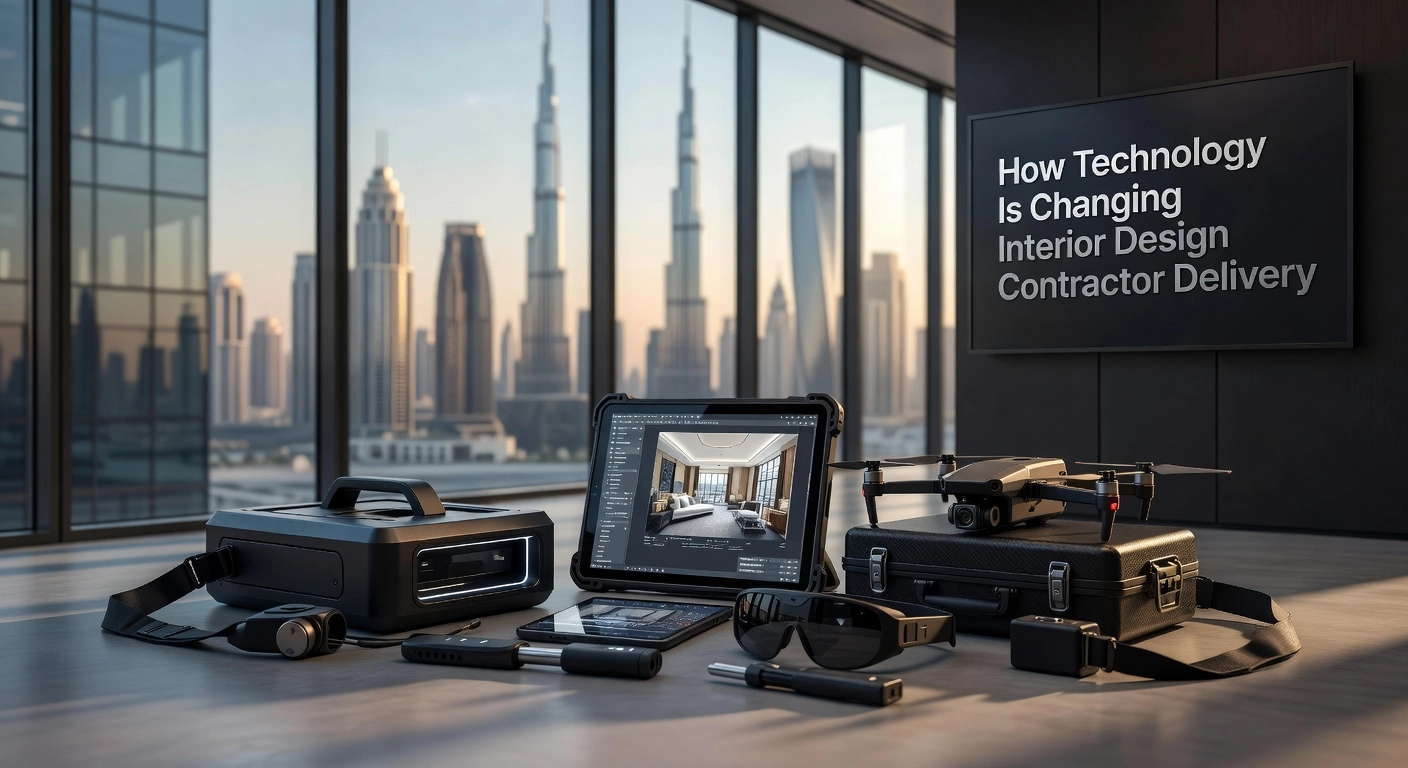
How Technology Is Changing Interior Design Contractor Delivery
The tools an interior design contractor brings to a Dubai project now carry as much weight as their portfolio. Across the hospitality, commercial, and residential segments, technology has shifted from a differentiator to a baseline expectation, and firms that have not invested accordingly are increasingly unable to compete for high-value engagements.
BIM coordination and digital twins represent the most consequential shift in how leading contractors manage pre-construction risk. By building detailed federated models that layer architectural, structural, and MEP data, firms can surface clashes between design intent and physical constraints before a single element is procured or installed. Dubai Municipality mandates BIM compliance for large and complex projects, and global BIM mandates for 2026 have made delivering major fit-outs without these workflows commercially unviable. The practical result is a dramatic reduction in costly on-site revisions, which historically represent one of the largest sources of budget overrun in hospitality fit-outs. Digital twin models extend this value further by enabling real-time monitoring and operational handover data that hotel owners and asset managers increasingly require at project close. For clients spending upward of AED 9,000 per square meter on premium fit-outs, this level of pre-construction coordination is not optional.
3D visualization and augmented reality tools have compressed the client approval cycle in ways that manual presentation methods simply cannot match. Hospitality clients can now walk through a photorealistic render of a lobby or restaurant interior, test material palettes, and assess spatial proportions before any procurement commitment is made. Firms using immersive VR and BIM-integrated visualization workflows report measurable reductions in late-stage design changes, which is particularly significant in hospitality where revisions after FF&E procurement carry substantial penalties. Approximately 60 percent of Middle East developers are expected to use digital twins and AR tools for design approval by 2026, a trajectory that reflects genuine operational value rather than novelty.
Modular and off-site fabrication for joinery, wall panels, and custom furniture is reshaping delivery timelines for Dubai hotel and restaurant fit-outs. Components manufactured in controlled factory environments arrive on-site with consistent tolerances and finish quality that on-site production cannot reliably replicate, particularly under compressed schedules. VDC-integrated workflows for joinery and prefabricated fit-out components are increasingly paired with BIM models to ensure that off-site elements integrate precisely with structural and MEP conditions. This approach can accelerate overall installation timelines by up to 30 percent while simultaneously improving quality control outcomes.
Digital project management platforms have become a baseline expectation among sophisticated hotel operators and institutional clients. Real-time visibility into schedule adherence, RFI status, and procurement milestones allows ownership groups to manage risk across multiple concurrent projects and hold contractors accountable to committed timelines. Firms that can demonstrate integrated platform access, automated reporting, and AI-assisted delay prediction are increasingly preferred over those relying on periodic manual updates.
Collectively, these capabilities translate into a measurable competitive advantage. Contractors who invest in tech-enabled delivery produce more accurate cost estimates at tender stage, maintain tighter timelines through execution, and deliver better quality outcomes at handover, all of which are now decisive factors in contractor selection for the high-value Dubai projects driving the UAE interior design market toward its projected USD 3.11 billion valuation by 2031.
How Nujum Alrabie Delivers End-to-End Interior Solutions in Dubai
Nujum Alrabie (NAR) brings a structured, full-cycle approach to interior design contracting in Dubai that addresses one of the most persistent challenges facing project owners: the gap between creative vision and executed reality. Operating as a UAE-based architectural and interior design firm with a multicultural team of professionals, NAR manages engagements from the initial concept development stage through to final handover. This includes design documentation, fit-out coordination, and renovation management, ensuring that the design intent established in early project phases is preserved and accurately translated into the built environment. For clients navigating Dubai’s complex regulatory landscape and demanding project timelines, this continuity of oversight represents a material operational advantage.
Hospitality Expertise Aligned to Dubai’s Market Scale
NAR’s primary sector focus is hospitality, and this specialization carries direct relevance given the depth of investment currently flowing into Dubai’s hotel and F&B pipeline. With over USD 100 billion in committed capital supporting new hotel construction, resort development, and property renovations across the emirate, demand for firms that understand brand-aligned, experiential hospitality interiors is at an unprecedented level. NAR brings documented experience delivering creative interiors for hotels, F&B venues, and resort properties across the region, with an emphasis on design that balances aesthetic innovation with functional operational requirements. This is precisely the combination that global operators and regional developers require as Dubai positions itself to attract 40 million annual visitors by 2031.
A Consolidated Service Model That Reduces Vendor Risk
What distinguishes NAR’s service structure is its breadth beyond design documentation alone. The firm’s capabilities encompass renovation management for villas and commercial properties, fit-out works including custom carpentry and specialist finishes, maintenance services, landscaping including soft and hardscaping, and swimming pool design and build. Rather than requiring clients to coordinate between separate design consultants, fit-out contractors, and maintenance providers, NAR functions as a single consolidated partner across these workstreams. This model directly reduces the coordination friction and misalignment risk that commonly emerge when creative and execution responsibilities are distributed across multiple firms with differing priorities and contractual accountability.
International Perspective With Regional Execution Capability
Operating from its UAE base while delivering projects worldwide, NAR brings a dual advantage that resonates particularly with global hotel operators entering the Dubai market. International design perspective, informed by exposure to diverse markets, cultures, and hospitality typologies, is combined with precise knowledge of regional supply chains, local authority requirements, and the material preferences that perform in the Gulf climate. This combination shortens the learning curve for international brands unfamiliar with UAE project delivery norms. Clients benefit from a single point of accountability spanning creative direction, technical coordination, and operational project phases, eliminating the version-control and responsibility gaps that routinely cause budget overruns and timeline delays when design and execution are managed by separate entities.
Frequently Asked Questions About Interior Design Contractors in Dubai
How much does an interior fit-out cost in Dubai?
Premium residential and hospitality projects in Dubai typically exceed AED 9,000 per square meter, with luxury villa interiors commonly ranging between AED 9,100 and AED 11,250 per square meter. High-end restaurant and hospitality fit-outs can reach AED 19,000 per square meter when imported luxury materials, artisanal finishes, smart building systems, and complex MEP requirements are factored in. Standard commercial and mid-range residential fit-outs sit considerably lower, typically between AED 1,500 and AED 4,000 per square meter. Material cost volatility has added further complexity since 2023, with specialty imports such as stone, timber, and metals experiencing price increases of 15 to 20 percent. Clients should always request itemized quotes that include contingency provisions and confirm the validity period of any pricing submitted.
What is the difference between an interior designer fee and a contractor fee in Dubai?
Interior designer fees cover creative, conceptual, and documentation services, including space planning, 3D visualization, material specification, and technical drawing packages. These fees are commonly structured as a percentage of total project value, typically between 8 and 15 percent, or as flat or per-square-meter packages. Contractor fees, by contrast, cover procurement, labor, physical installation, site management, authority approvals, and project handover. Contractor costs generally represent 70 to 85 percent of the total project budget. Integrated firms bundle both services under a single contract, reducing coordination friction, minimizing change orders, and providing clients with a single point of accountability from concept through to completion. Separate engagements offer greater client control but demand careful interface management to prevent disputes at the design-to-execution boundary.
How long does a typical hospitality fit-out project take in Dubai?
Hotel room renovations in Dubai commonly run between 8 and 16 weeks per floor, depending on scope, brand-standard compliance requirements, and the need to minimize disruption to operational areas. Full food and beverage outlet fit-outs typically range from 12 to 24 weeks, measured from design completion to formal handover, accounting for custom joinery fabrication, MEP coordination, and municipality approvals. Fast-track projects driven by seasonal deadlines, such as refurbishments ahead of peak tourism periods, can compress timelines through off-site prefabrication and extended shift patterns. Early contractor involvement during the design phase, particularly under an integrated delivery model, consistently reduces program risk by resolving procurement lead times and approval sequences before construction begins.
Do interior design contractors in Dubai need a government license?
Yes. Any firm managing fit-out or construction works in Dubai must hold a valid contractor license issued by the Dubai Department of Economic Development, the relevant municipality, or the applicable free zone authority. Design-only consultancies may operate under an interior design or creative cluster license, but firms performing on-site physical works require contractor registration, engineering approvals, and in many cases pre-qualification on the Dubai Municipality Contractors and Consultants Register. Clients should verify licensing credentials through official government portals before executing any contract. Engaging an unlicensed contractor exposes a project to regulatory penalties, insurance invalidation, and significant program delays.
What should a client include in an RFP for an interior design contractor in Dubai?
A well-constructed RFP is the foundation of a competitive and accurate tender process. It should specify project type, sector, approximate area in square meters, location, and preferred contract model, whether lump-sum, design-build, or construction management. Budget range or target cost per square meter, key milestone dates, and the required handover date must be clearly stated. The RFP should define deliverables at each project stage, from concept and schematic design through to construction documentation and as-built drawings. Any brand or operator standards, sustainability targets such as LEED or Estidama requirements, and technical mandates covering MEP, smart systems, or accessibility must be included explicitly. Supporting the submission with existing site conditions, reference imagery, and clear evaluation criteria ensures that responding firms can produce proposals that are genuinely comparable and actionable.
Choosing the Right Partner for Your Dubai Interior Project
Selecting the right interior design contractor in Dubai requires structured due diligence, not just a review of portfolio imagery. Before shortlisting any firm, verify three foundational credentials: a valid license issued by the Department of Economic Development or relevant free-zone authority, demonstrable sector experience in your project type, and integrated delivery capability covering design, fit-out, and handover within a single engagement. These factors directly determine whether a firm can absorb operational risk or simply transfer it back to the client.
Process documentation is the most reliable indicator of execution maturity. Request detailed phasing plans, quality control protocols, procurement timelines, and change-order procedures. A firm that can only present visuals but not structured delivery methodology introduces avoidable exposure on complex projects.
Benchmark every proposal against current market data. Premium fit-outs in Dubai exceed AED 9,000 per sqm, and hospitality projects typically require 12 to 24 weeks for delivery. These figures provide realistic anchors for assessing whether a proposal reflects genuine market understanding or optimistic underquoting.
Given Dubai’s USD 100 billion hospitality pipeline, prioritize firms with verifiable hotel and F&B track records. The acoustic requirements, guest-flow complexity, and brand compliance standards specific to hospitality delivery demand specialized experience that general interior contractors rarely possess.
To explore an engagement with a firm built around integrated hospitality design and execution, contact Nujum Alrabie directly to discuss your project brief, timeline, and scope requirements.
Conclusion
Choosing the right interior design contractor in Dubai is one of the most important decisions you will make for your project. To recap the essentials: always verify trade licenses and credentials, review past projects with a critical eye, understand payment structures before signing anything, and prioritize contractors who communicate clearly and consistently.
The difference between a dream space and a costly mistake often comes down to how thoroughly you vet your options upfront. Taking time to ask the right questions and spot red flags early will save you significant stress, money, and delays down the line.
Now it is time to put this framework into action. Start building your shortlist today, request detailed proposals, and trust your due diligence over flashy social media feeds. Your ideal Dubai interior is closer than you think; the right contractor will help you get there.
0 comments